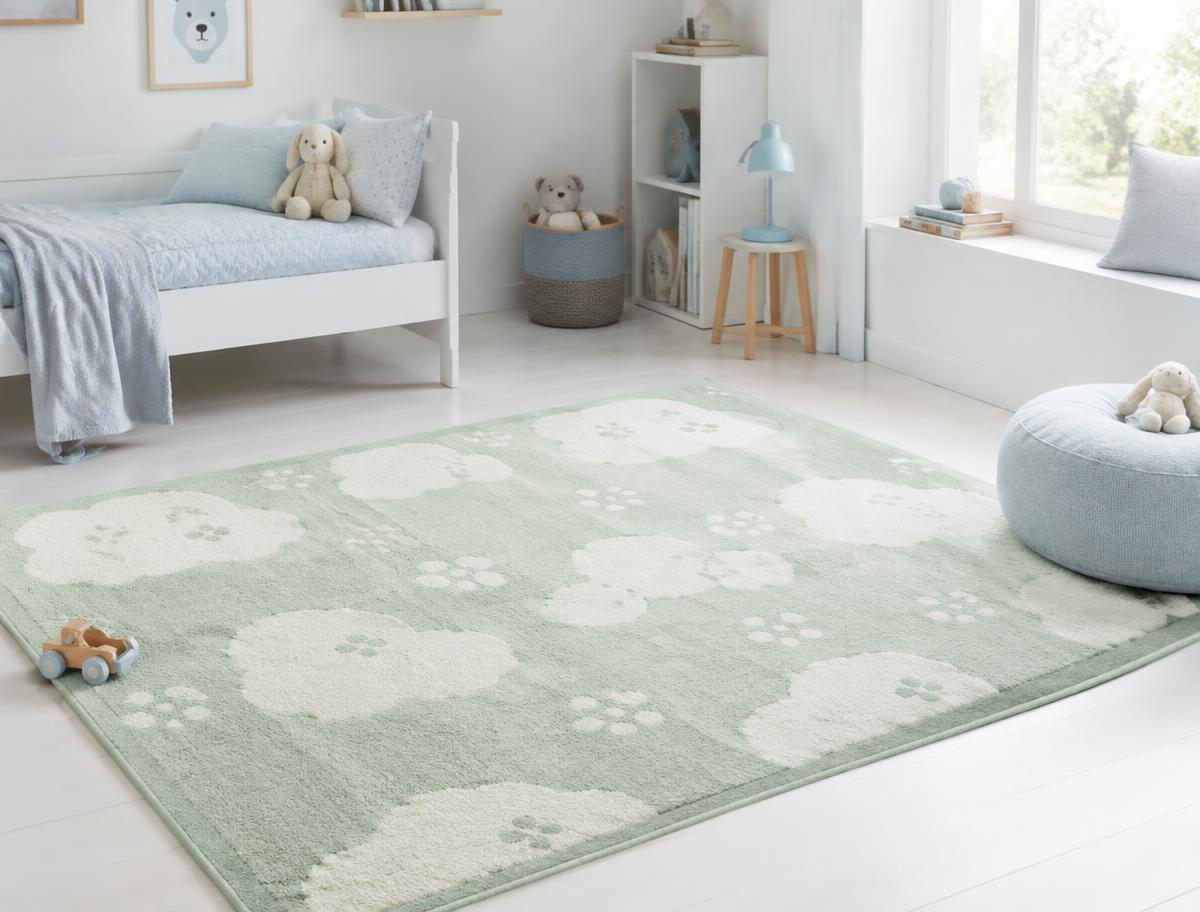
Why it is the nursery specialist
Most washable rugs are general-purpose products that happen to suit a nursery. Lorena Canals runs the other direction: the sizes, the shapes, the palettes and the weight of the rug are all set by what a baby's room needs. That produces small differences that matter in practice — a 4x6 that fits under a crib and a glider without buckling, a profile low enough that a door clears it, colors chosen to sit against white furniture, and a weight one parent can move alone while holding a baby.
Materials and what a baby is lying on
The pile is cotton, with a meaningful share of recycled cotton content in several lines, on a handmade woven construction. There is no attached foam pad, no PVC sheet and no adhesive layer — which is the specification that matters most when the rug is the floor a baby spends hours on. The brand references third-party textile testing across several lines; as with every product on this site, we publish a specific certification only once we can tie the documentation to the exact finished product, so the badge is absent here by policy, not because the materials are in doubt.
Washing a nursery rug in practice
Nursery and kids sizes go into a standard home washer whole. Cold, gentle, no bleach or softener, and air-dry flat — a full day for the larger sizes, longer for shaped and layered designs where the edges dry slower than the middle. The mid-size room rugs need a large-capacity machine. Plan on the rug being out of the room for a day, which for most families means washing on a weekend rather than after a Tuesday-night spill. If a same-day turnaround matters more than fiber, our Easiest to Clean pick is the better fit.
Comfort and floor time
Soft, warm and low. It is a flat handmade cotton, not a plush pile, so it is pleasant for tummy time and crawling but does not cushion a fall on its own. We would pair every nursery rug, this one included, with a felt-and-rubber pad: it adds real underfoot give, stops the rug traveling when a toddler pushes off it, and extends the life of the cotton by taking the abrasion against the floor.
Design — the reason people choose it
Scalloped edges, cloud and animal shapes, woven tonal patterns, and a pastel palette tuned to nursery furniture. It is genuinely charming in a way that is hard to fake, and it is also the source of the main criticism: a cloud-shaped rug is a nursery rug forever. If you want a rug that survives the transition from nursery to big-kid bedroom to living room, a striped flatweave — our Best Overall pick — is the more durable design decision.
Durability, traffic and pale colors
Handmade cotton in a low-traffic room should hold up for years; the wear pattern to expect is gradual flattening in the path between the door and the crib, plus edge softening. The real durability issue is chromatic rather than structural — the pale ivories and soft pinks that make the designs work also show traffic and soil sooner than a mid-tone. Washing resolves it, which is the point of a washable rug, but it means you will wash more often than you would a darker rug.
Price and value
This is the most expensive per square foot of the washable cotton rugs we track, and Value is its lowest score. You are paying for handmade construction and a design range nobody else offers. Whether that is worth it comes down to how much the look of the nursery matters to you: as a purely functional washable cotton rug, there are cheaper paths to the same clean floor.