
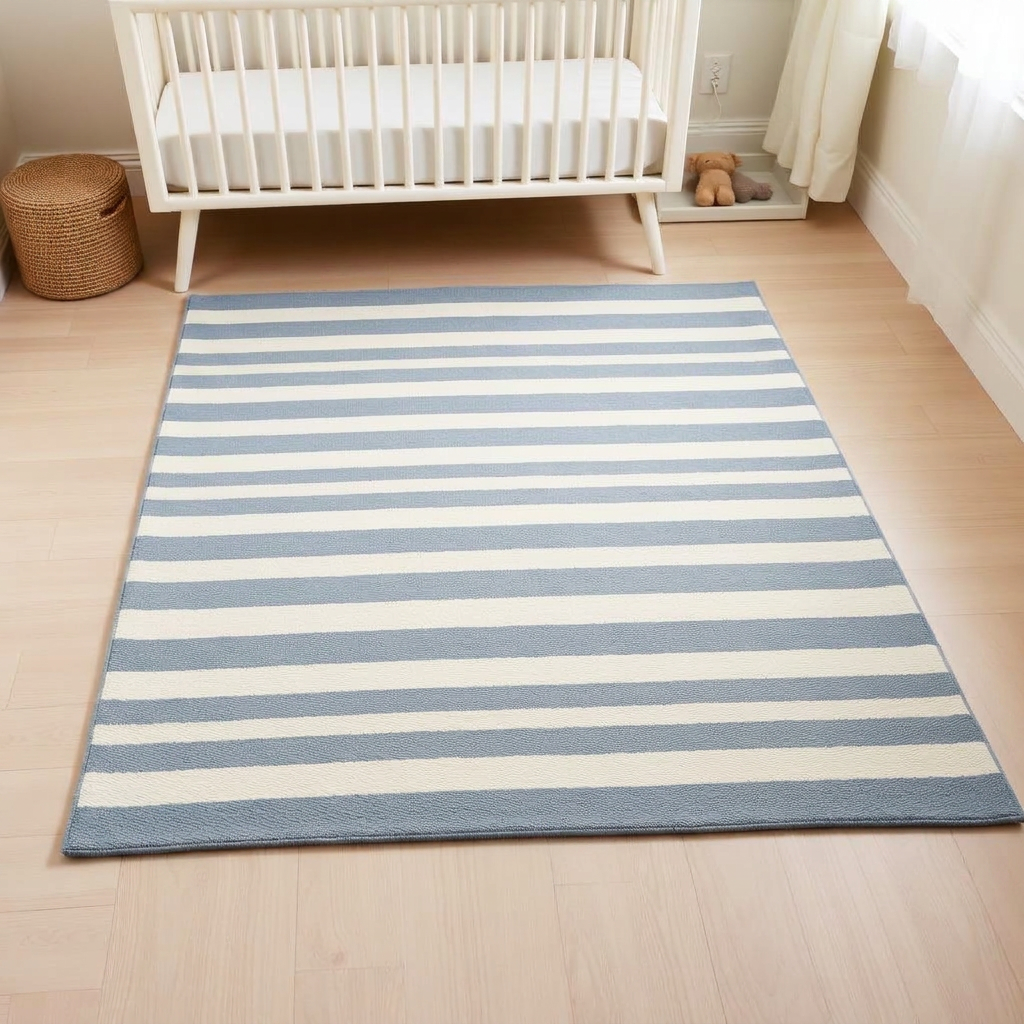
Best Non-Toxic rug of 2026

Why Little Woven is our best non-toxic rug

Our non-toxic award is really an award for what you can verify. Here is exactly which layers this rug has, which it does not, and where our certification research stands.

Best Non-Toxic
MHMaren HollowayPublished February 4, 2026 · Updated September 19, 2026Testing methodology

The short answer

Why Little Woven takes Best Non-Toxic

Little Woven wins this category by subtraction: a cotton pile, color woven into the yarn rather than printed on it, and none of the foam, latex or PVC layers that make the non-toxic question unanswerable on most washable rugs.

Little Woven Little Woven Heirloom Stripe Washable Cotton Rug

How it scored

9.5/10

Fiber disclosureMaterials pillar
9.8

Published as organic cotton with the construction described, rather than the generic 'natural fibers' line that makes most listings unverifiable.

Backing and adhesivesConstruction pillar
9.7

No attached foam pad, no latex sheet, no PVC backing — the three layers that carry most of the chemistry questions in this category.

Dyes and surface finishesMaterials pillar
9.5

Color is carried in the yarn rather than printed on the face, so there is no surface print layer or coating sitting on top of the fiber.

Stain treatmentsMaterials pillar
9.4

A washable rug does not need a permanent stain-repellent finish, and that absence is a point in its favor rather than a missing feature.

Certification documentationCertifications pillar
9.0

The lowest score here on purpose. We have not verified finished-product certification documentation yet, so no badge is published.

Evaluated using published specifications, fiber and construction disclosures, manufacturer documentation and customer-reported durability. Not yet physically tested in our washable rug protocol.

The case in full

Our Best Non-Toxic argument

What we mean by non-toxic

We use the term narrowly, because used loosely it means nothing. Our non-toxic award is not a health claim and it is not a lab result. It is a verifiability award: it goes to the rug where you can actually find out what you are putting on your floor. That means disclosed fiber content, a construction you can count the layers of, and no coatings or adhesives the manufacturer declines to describe. On those terms, most of the washable rug market fails before the conversation starts.

Layers are the whole story

Almost every chemistry question about a rug traces to a layer that is not the pile. A glued foam pad needs adhesive. A latex sheet needs plasticizers and stabilizers. A PVC backing is a plastic sheet. A printed face needs a binder to hold pigment on the surface. A stain-repellent finish is a chemical applied to the fiber after it is made. Little Woven is one woven cotton layer with color in the yarn: no pad, no sheet, no print binder, no repellent. Every layer it does not have is a question you do not have to ask.

Why washability and non-toxic belong together

A rug you can wash is a rug you do not have to chemically treat. Stain-repellent finishes exist because most rugs cannot be laundered — the finish is a substitute for cleaning. Remove that constraint and the finish becomes unnecessary. The same logic applies to professional cleaning: a washable cotton rug never needs the solvent-based process a wool or viscose rug eventually does. Non-toxic is not only about what is in the rug when it arrives; it is about what you will have to put on it for the next five years.

Where we are on certifications

Little Woven describes its cotton as organic and references testing. We have not published a certification badge on this site, for this or any product, and we will not until we can tie documentation to the exact finished product rather than to a fiber or a mill. That policy costs Little Woven points here — its certifications pillar is 9.0, its lowest score in this category — and we would rather show you a lower number honestly than a badge we cannot stand behind. If you need documented certification in hand before buying, ask the brand directly for the finished-product paperwork.

How the rest of the field compares

Ruggable is a polyester cover on a polyurethane-backed pad — stable, but fully synthetic with layer chemistry that varies by collection, which is why it takes our cleaning award and not this one. Lorena Canals is the closest competitor here: also cotton, also single-piece, and a strong choice for a nursery, but with less specific published disclosure. Revival is natural wool with no adhesive in a hand-knotted build, which is genuinely excellent on this axis, but it cannot be washed. Rugs USA spans everything from jute to viscose blends, so there is no single answer to give.

What we would still check before buying

Ask for the current finished-product test documentation if it matters to you. Buy a felt-and-rubber rug pad rather than a PVC one — the pad is a layer people forget, and it sits under the rug your child crawls on. And air any new textile out for a day before it goes into a closed nursery, which is good practice for anything woven, coated or not.

FAQ

Best Non-Toxic questions

Is Little Woven certified non-toxic?
We have not verified finished-product certification documentation, so we do not publish a certification badge. Our award is based on disclosed cotton fiber content, yarn-dyed color and the absence of foam, latex and PVC layers — things we can confirm from the published construction.
Why does the absence of a foam backing matter?
Because the backing is where most of the chemistry in a washable rug lives. A bonded foam or latex pad requires adhesive, and adhesive plus repeated washing is also the most common structural failure in the category. Removing the layer removes both problems.
Is a synthetic rug unsafe?
No, and we would not say so. Modern polyester and polypropylene are stable, low-emission fibers once aired out. Our non-toxic award is about disclosure and simplicity of construction, not about declaring other materials dangerous.
What about the rug pad?
Buy the pad as carefully as the rug. We recommend felt-and-rubber pads over PVC ones, cut slightly smaller than the rug. It is the layer most people never think about and it sits directly under the surface a baby plays on.